
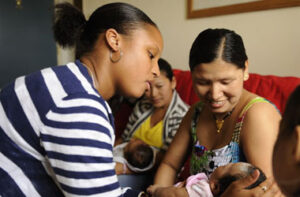
“Que linda es,” (How pretty she is) the nursing student tells the mother of the smiling baby. This baby is special to the student. As a Birth Companion to the baby’s mother, she helped facilitate a birth plan for the family, supported the mother during the labor process, and visited the family shortly after the birth.
Tonight mother, baby, and student are attending a very big birthday party at School of Nursing. They’re celebrating all the recent births supported by the Birth Companions program. Hands reach out to cuddle the babies and—because many of the students are Returned Peace Corps Volunteers who have served in the mothers’ countries of origin—voices soothe the babies with the lullabies of South America, Africa, and Asia. But it’s not just cake, ice cream, and cooing at this party.
About the program
Birth Companions support women before birth, during labor and birth, and after birth with their continuous presence and complementary interventions. They provide emotional, informational, and physical support to women and serve as an advocate during the entire childbirth process.
The program has received local and national recognition for its work with women and families including The Daily Record’s Health Heros, Premier Cares Finalist for two years and a Henrietta Lacks Award Finalist.
The program trains student nurses to serve in a doula role and accompany women and families during the childbirth process. Students receive doula training from a certified dula educator and learn about maternal-child and public health from school faculty when they take the course.
What do Birth Companions do?
- Before you give birth, Birth Companions will meet with you to talk about your birth plan and answer any of your questions.
- When you give birth, your Birth Companions will stay with you, and comfort you with massages, back rubs, and soothing compresses.
- A few days after you give birth, Birth Companions visit you and your baby. They can talk with you about feeding and caring for your baby.
What skills do Birth Companions have?
- Golden Hour Birth Doula Training to provide support to women giving birth
- Nursing experience as currently enrolled students at Johns Hopkins University School of Nursing
- Spanish and other language skills
Mothers who are supported by doulas show more affectionate interaction with their infants. This involves significantly more smiling, talking, and stroking. Six weeks after childbirth, women who use doulas are more 51% more likely to breastfeed compared to 29%, are significantly less anxious, have lower scores on a test of depression, and have higher levels of self-esteem.
Birth Companions:
Provide their service free of charge.
Work only at the woman’s request. They are not employees of the medical staff or the hospital.
Will accompany the mother to the hospital of her choice, where she has planned to give birth.
Work only in the role of doula. Though they are nursing students, they do not perform any clinical care to the mothers they serve.
Before labor, Birth Companions will:
Meet with the woman (and her partner, friend or family member) to become acquainted, discuss priorities, explore any fears and concerns, and plan how they can work best as a team.
Help develop a personal birth plan, including preferences regarding pain management, coping with pain and fatigue, and interactions between the woman, partner and family members.
History
1997: The Birth Companions Program was started by nursing students interested in doula care. Faculty members offered the training and students provided on-call doula services at the Johns Hopkins Bayview Medical Center.
1998: A two-credit clinical course was taught by a trainer certified by the Doulas of North America (DONA). The course taught theories of maternal and community health nursing and the use of supportive techniques during childbirth, such as massage, breathing methods, different body positions, cold compresses, hot showers, and birthing balls.
Students learn about post-partum health, infant care, and breastfeeding. They learn to communicate with doctors and nurses about a mother’s birth plan and help identify other community resources for women.
Today: Each year, 60-80 baccalaureate students take an elective course. While students are trained with a certified birth doula, they have the option to be certified through Golden Hour Birth Doula Training Institute. Students provide doula care to one client, making a prenatal and a postpartum visit to the mother and attending her labor and birth at the hospital of the mother’s choosing in the Baltimore metropolitan area. Students who choose to take on additional clients are paid for their services through the School of Nursing.
During labor, Birth Companions will:
Assist pregnant women in having a satisfying birth experience.
Advocate for the mother and support her decisions throughout the childbirth process.
Provide emotional support, physical comfort, and information women often need during labor.
Help with comfort techniques such as relaxation, massage and positioning.
Work only at the woman’s request. They are not employees of the medical staff or the hospital.
Birth Companions will not:
Perform clinical tasks, such as blood pressure, fetal heart monitoring, vaginal exams, or administer medications.
Make decisions for the mother and her family. Instead, they discuss concerns, suggest options, and get information necessary for the family to make informed decisions.