

When Instructor Alexander Halstead, DNP, CRNA, FNP-BC, was asked to develop the first Johns Hopkins School of Nursing advanced practice curriculum for point of care ultrasound (POCUS), an underutilized (and largely untaught) diagnostic method, he jumped at the chance.
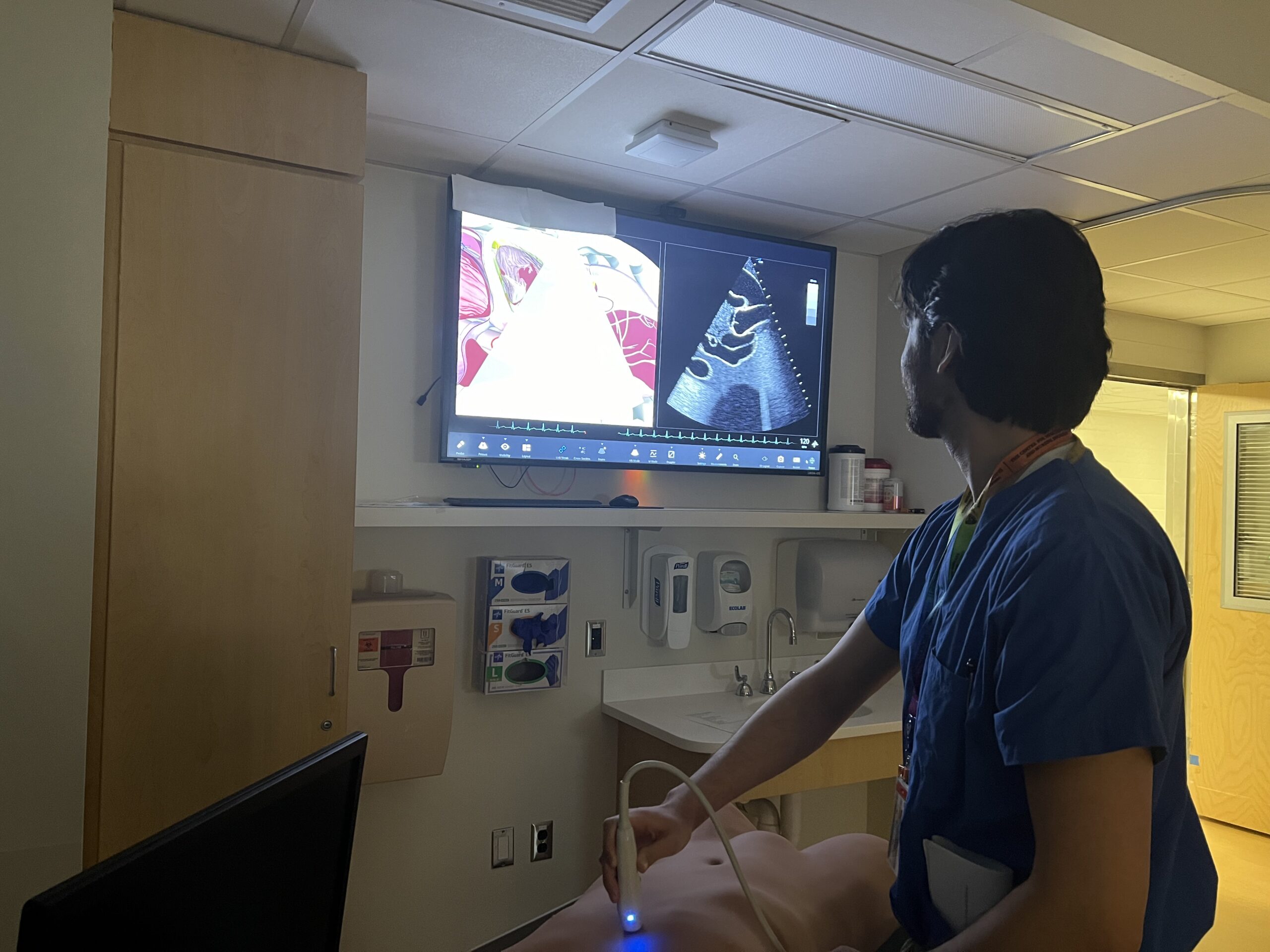
Halstead, faculty with the Johns Hopkins School of Nursing (JHSON) since 2022 and a full-time instructor with the DNP Anesthesia track since 2024, understood from experience what POCUS could do to improve patient outcomes and save lives in an emergency. What he didn’t know was what tools might be available—looking within Johns Hopkins University first is never a bad idea. Divisions within the School of Medicine already had some of the necessary technology—including a simulation mannequin designed specifically to teach POCUS.
And, presto! Halstead had taken the first steps toward what today is a unique and expanding curriculum.
Ultrasound technology is obviously not new. What POCUS does is bring ultrasound up front in patient care, “shifting clinical assessment from inference-based methods to real-time, image-guided decision-making at the bedside.” It saves time, giving caregivers down the line a heads up and patients a better chance at positive outcomes from a scheduled procedure or in an emergency.

“My first nursing job was at University of Maryland Shock Trauma,” Halstead explains. “One of the attendings I worked with was chair of the critical care ultrasound program. Patients would fly in, he’d POCUS them at the bedside and call a surgeon and say, ‘Hey, the patient is having an aortic dissection,’ and the surgeon would ask, ‘How do you know that? I’m in their medical record right now and I don’t see a CT scan.’ They didn’t need to go to scan. They needed to go to the operating room.”
“POCUS has been shown to improve diagnostic accuracy and speed, leading to reduced time to appropriate treatment and shorter hospital length of stay,” Halstead says. “Randomized and observational studies demonstrate that POCUS-guided management can decrease complications and mortality in specific settings—such as trauma, cardiac arrest, and undifferentiated shock—by enabling earlier diagnosis and targeted interventions.”
For JHSON and its students, POCUS training offers one more opportunity to lead.
“Many nurse anesthesia programs are not equipped to teach [POCUS] yet,” explains Halstead, “and we’ve had it in our program since 2023. We were early adopters, and now we’ve incorporated it into the Acute Care Nurse Practitioner programs as well.”
He expects POCUS to keep gaining converts and JHSON to keep turning out experts. Both are essential, he insists. “Our graduates, our advanced practice graduates specifically, need to have the skills to keep up with the demand of the increasingly complex, increasingly high-acuity, and increasingly sick patient population that we care for. … For students, POCUS is quickly becoming a core expectation rather than an optional skill.”
In fact, POCUS is now required by Council on Accreditation of Nurse Anesthesia Educational Programs (COA), Halstead reports.
“I believe that bedside real-time ultrasound will eventually replace the stethoscope, because it offers far greater diagnostic reliability and specificity than any other bedside assessment. … In the OR, it’s all vital sign based, right? We have no imaging of the heart, of the lungs. We have no way of seeing inside the body besides the number readouts on our screen,” he says. “That’s where POCUS comes in, to allow clinicians to see under the skin at the underlying physiology.”
Because it is simulation via a mannequin, Halstead and his colleagues can program a POCUS simulator to paint students into a corner and—in a safe learning space—help them learn to trust themselves, their training, and the technology to get them and a patient out. And then do it again. Halstead loves this stuff.
“My plan is to continue spreading the gospel—preaching and gathering evidence to support spreading this education nationally into advanced practice nursing education, promoting clinical integration, and disseminating best practices for teaching and learning this essential set of skills.”