
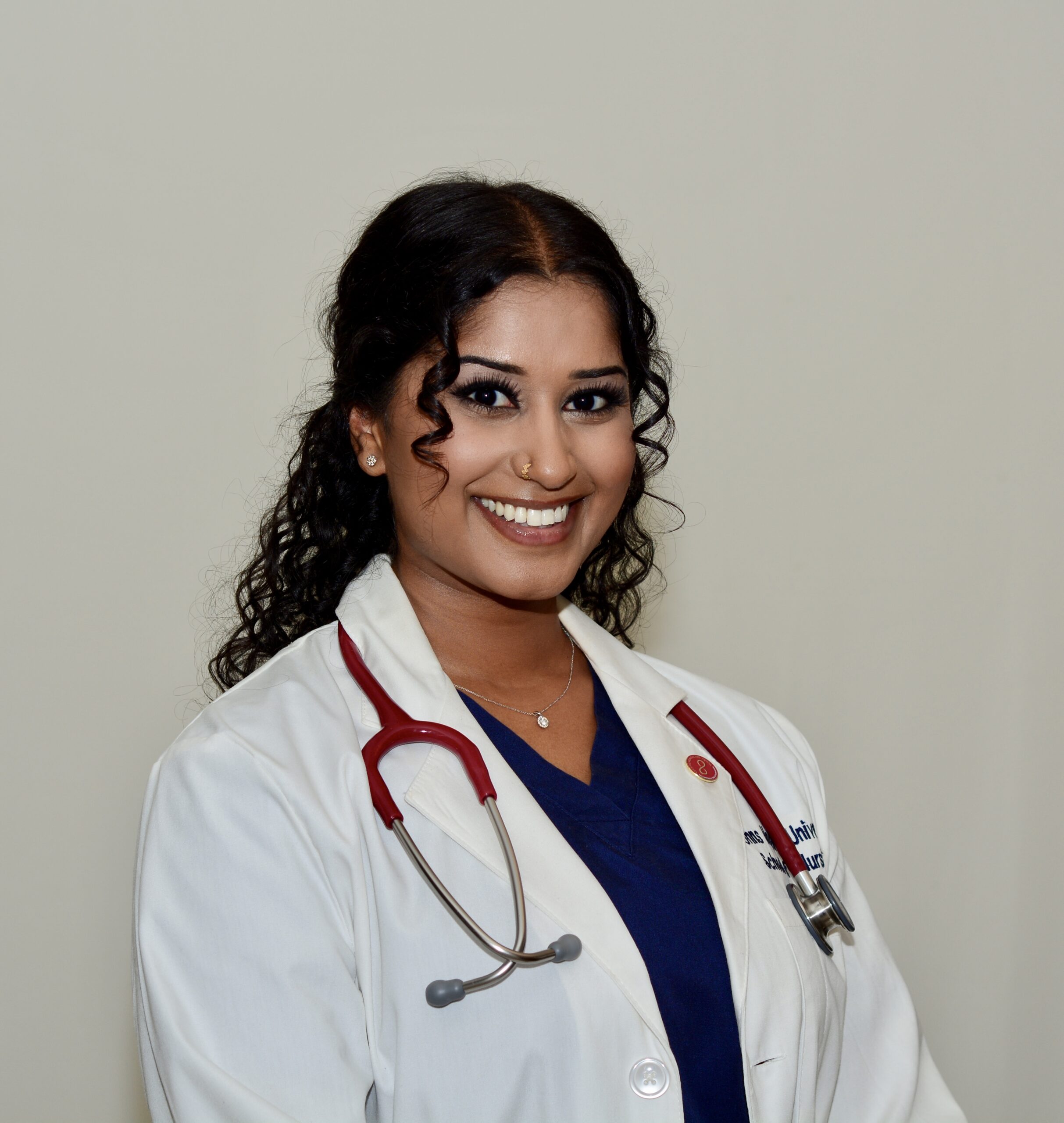


Helping young people see a way out of despair in their darkest times is good for Shobha Ambi’s mental health too. “It’s nice to know that I’ve been able to make a meaningful impact on people,” explains Ambi, a student in the DNP Psychiatric Mental Health Nurse Practitioner program at the Johns Hopkins School of Nursing. (She earned her master’s degree at JHSON, with a Fuld Fellowship, in 2023.) “Just knowing that they are now able to see a future that they never could have imagined before, that they actually feel hope, that is … I’m getting emotional just thinking about it.”
Ambi is a mental health nurse born and raised in Irvine CA and now working at an acute psychiatric inpatient hospital in Orange County. She’s also part of the Sri Lankan community that her parents joined as immigrants in the 1990s. “Helping your community creates a great sense of strength and love that people may have never felt they had. Any marginalized community: Let them know that there’s someone out there who cares. They aren’t alone.”
It was at a time when so many struggled to find hope—2020, amid the COVID pandemic—that Ambi was inspired to cofound Children Don’t Suffer in Silence, a nonprofit that works to destigmatize mental health in Sri Lankan culture, particularly regarding care for children. Her cofounder is a pediatrician. “As soon as the world shut down, I wanted to find a way to continue the conversation, because the mental health crisis really skyrocketed,” she explains.
Any marginalized community: Let them know that there’s someone out there who cares.
Children Don’t Suffer in Silence is aimed toward Sri Lankan-Americans as young as elementary school. “But it’s really open to all people.” There are physical meetups once a year, virtual visits the rest of the time. Participants are offered a safe space to get used to the idea of asking for and accepting help.
“A lot of these kids I’ve known for a long time,” says Ambi. “They can come talk to me, not be scared that any information is going to their parents, just kind of vent.” If necessary, and they are ready, Ambi can refer young people to specific mental health services. “Seeing a medical professional in an office, that can be kind of scary. So I see us kind of as a stepping stone.”
Ambi understands these children and young adults better than many providers could. “I was in that community. Mental health was never really talked about.” Then, as a teen, “a very close person in my life” attempted suicide. “I had to physically take a knife away from their neck. … That’s when I realized, this is something we really need to work on, especially at this age.”
Her efforts to serve the Sri Lankan community extend globally as well, particularly through Anpuneri, a project launched in 2009 (she helps raise $60,000-$80,000 annually). Anpuneri assists war-affected Tamil Sri Lankans by providing food and housing for widowed families and the disabled as well as laptops for university students and motivational workshops for high schoolers, fostering shops and farms to help families create income.
Headed toward graduation from the DNP program at JHSON, Ambi has no interest in slowing down. Rather, the DNP means she can “keep doing what I’m doing, at a stronger level.” She recognizes the need in her community, and very likely in yours.
“The thing with mental health, I love to remind people that struggles are sometimes unnoticeable. There are no physical signs for a majority of people. Your best friend, your colleague, your boss could be experiencing distress and they could be going around, like, ‘Hey, Shobha! How are you doing this morning? Let’s go grab a chai.’ ” Sure, Ambi would love some tea, and the chance to listen.
“Even helping one person makes the biggest difference. It’s beautiful to see.”
Learn more about the DNP Psychiatric Mental Health Nurse Practitioner program at the Johns Hopkins School of Nursing.