

Cameo Blankenship looks ahead to CRNA, appreciating what’s taken him this far.
As a linebacker at Davidson College in North Carolina, Cameo Blankenship’s job was to diagnose a play before it happened, then beat his opponents to the football. He was built for that not just as a lifetime three-sport athlete but as someone who can’t help but look way ahead.
“I am one for very deliberate planning,” understates Blankenship of a plan he hatched as a teen in McRae GA to one day get into a top nursing school, ace it, and keep going until he became a certified registered nurse anesthetist (CRNA).
Fine, said his dad. But first, he would accept the scholarship from Davidson to play football (and eventually join the wrestling team) while earning a bachelor’s degree. Blankenship chose psychology, with minors in neuroscience and public health. All the while, he kept planning.
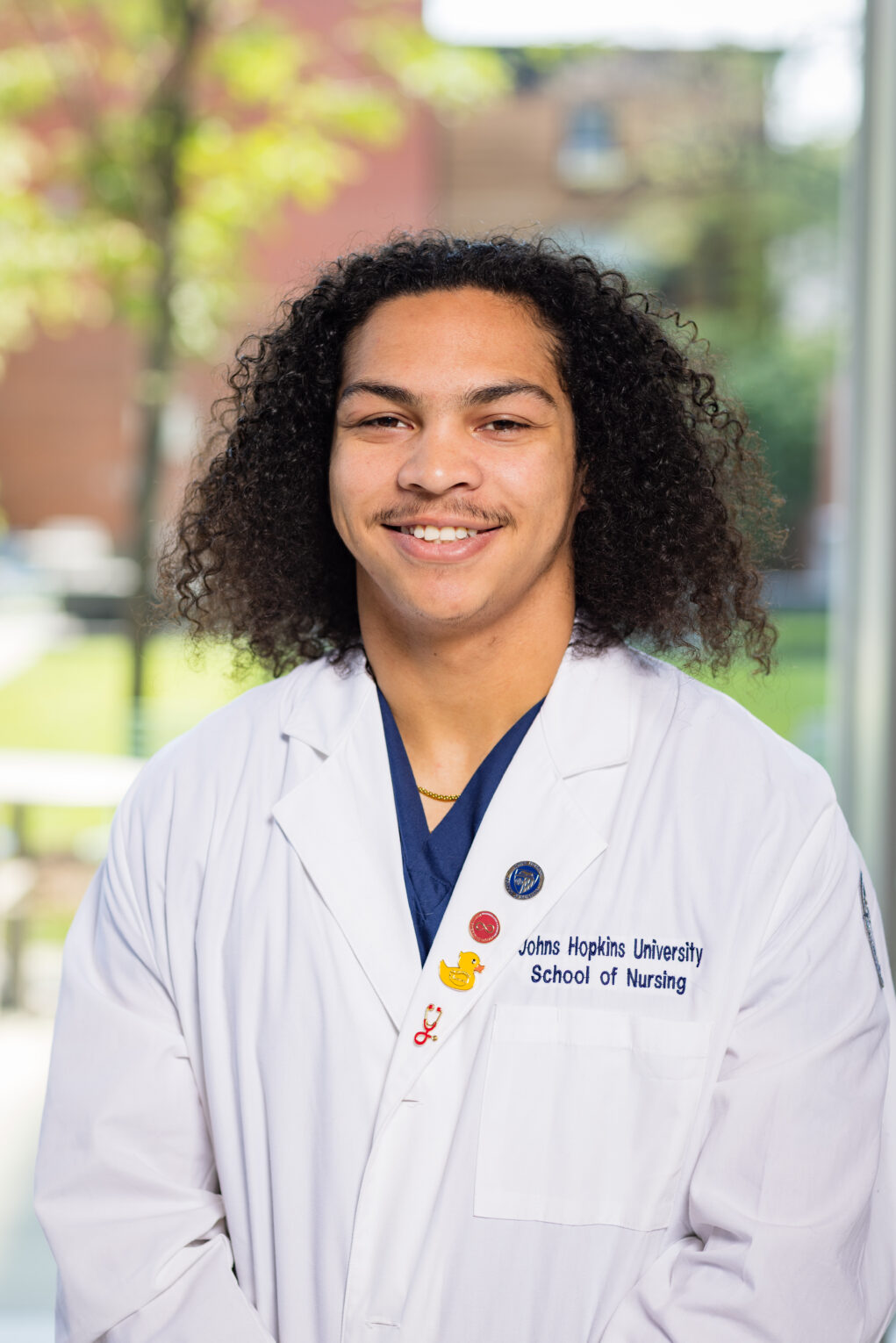
As a sophomore, he started reaching out to nursing schools, among them Johns Hopkins (JHSON). That’s when his queries first hit the inbox of Alexander Murphy, now assistant director for DNP Advanced Practice Recruitment in the Admissions Office but a newbie back then. “We became like pen pal buddies, because year to year I’d bounce stuff off him. He literally led me down the path of how to be most successful getting toward Johns Hopkins,” says Blankenship of regular email huddles that offered encouragement to join JHSON, of course, but also all manner of advice on clearing hurdles on the path—to East Baltimore or wherever else. “If they’re giving me this much attention before I even step foot on campus, how much more of a community is it when I actually get there?” Blankenship chose to join the Master’s (Entry into Nursing) program.
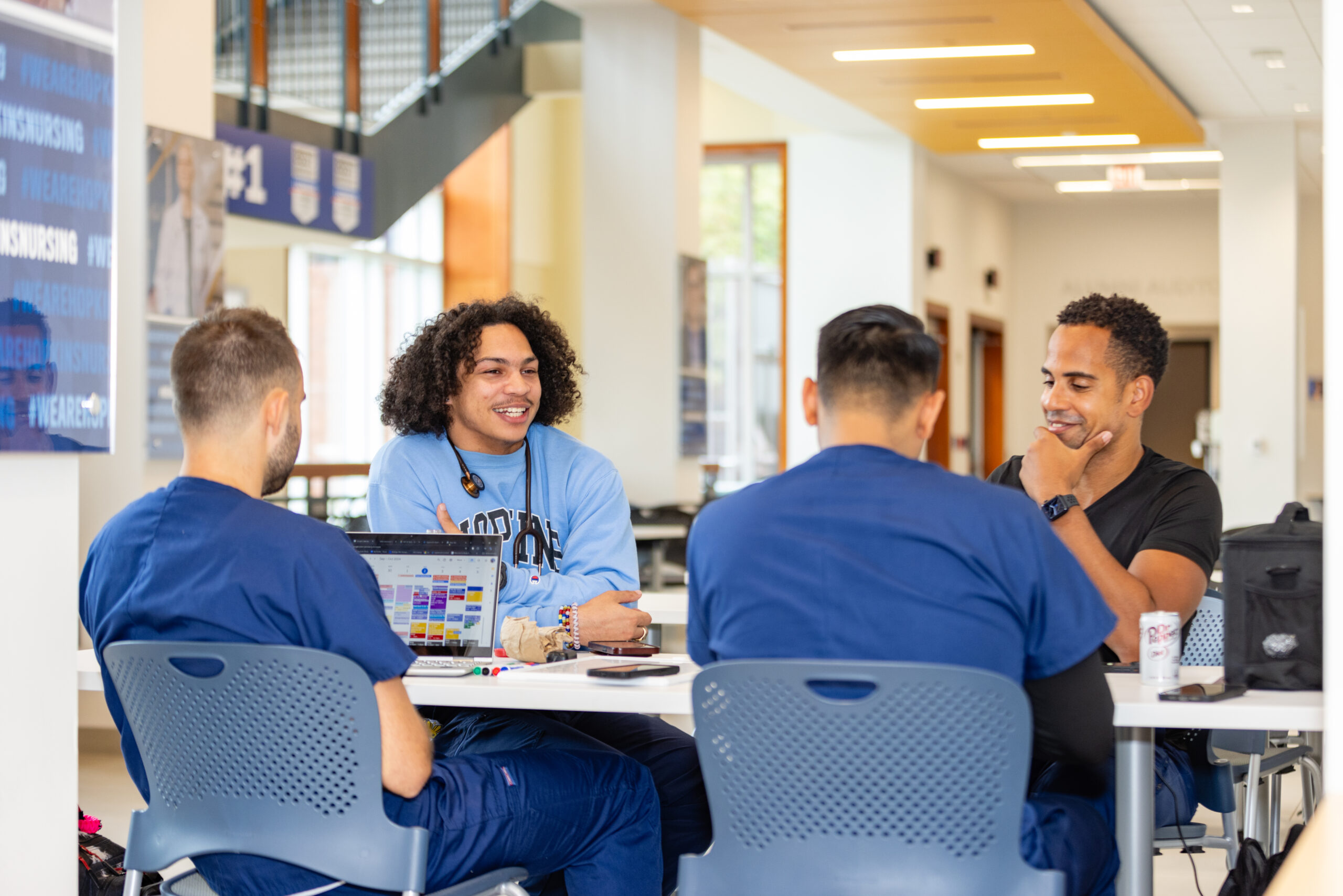
Asked to share his favorite spot on campus, Blankenship doesn’t hesitate: “I’ve spent about 90 percent of my time as a student here at the same table with my boys.” In the lobby of the Pinkard Building, you couldn’t help but find them around that long, white table studying, eating, shooting the breeze, supporting one another through the mind-expanding curriculum. Blankenship came to the Johns Hopkins School of Nursing on the promise that he’d find a group like them, like him. Eager to join a profession that has traditionally leaned strongly female, Blankenship wanted to know he’d be accepted, and that he’d have a little company.
Since 2019, JHSON has been named a Best School for Men in Nursing by the American Association for Men in Nursing, part of an overall effort at the school to increase diversity in all forms among students, faculty, and staff. “It’s been even better than I expected,” says Blankenship of the regularity of having men—especially black males—as well as women and so many other colors and backgrounds as colleagues in class and in clinicals. And his boys? “We have a whole club. It’s a very tight-knit community.”
After a tip about a diverse CRNA conference coming up in New Orleans, a wonderful opportunity to learn and a networking dream scenario, Blankenship figured this was his shot. Of course, it was something this planner hadn’t seen coming.
Blankenship wasn’t the first and won’t be the last to end up at the office door of Jermaine Monk, PhD, MSW, MA, associate dean for diversity, equity, inclusion, and belonging. Sure, this trip meant Blankenship would learn about and possibly be recruited by other schools with a CRNA program, but a JHSON student needed assistance. He walked away with an itinerary. “Dr. Monk helped me set everything up,” Blankenship explains. “It would not have been possible without his help.”
I just want to be an advocate for not only CRNA but nursing on the biggest scale.
The conference was just as Blankenship had hoped, and more. “I met people from Chicago, Philly, Texas, California.” Let him tell you about the hard sell from the University of Nevada Las Vegas sometime. (Or maybe let what happens in New Orleans stay in New Orleans.) As a JHSON grad, Blankenship will be in demand, when he’s ready.
And it’s got him once again planning several years down the road—his comfort zone—as his wife works her way through law school and then he takes his turn.
“My career hope is, obviously, to go to CRNA school. But I’m hoping that with a certain amount of career experience, I can shift some of that into legislation, maybe influence some policies for CRNAs as being a core group at the founding of anesthesiology. The history of being a CRNA, the people who laid groundwork coming forward, is very important to me. I just want to be an advocate for not only CRNA but nursing on the biggest scale.”
He can’t wait for the opportunity or the hard work to get there. “I’ve been decently successful at three sports [including baseball],” Blankenship emphasizes. “And so I’ve always looked for a challenge in everything that I do. Things that aren’t challenging tend to just fall off my radar.”